

A common question: how can the model give a confidence from only a few lines of evidence? It doesn’t make up a confidence from the amount of evidence. It reads one from the shape of its answer. Small evidence does not break it. It admits “I’m not sure”. Refer the below diagram:
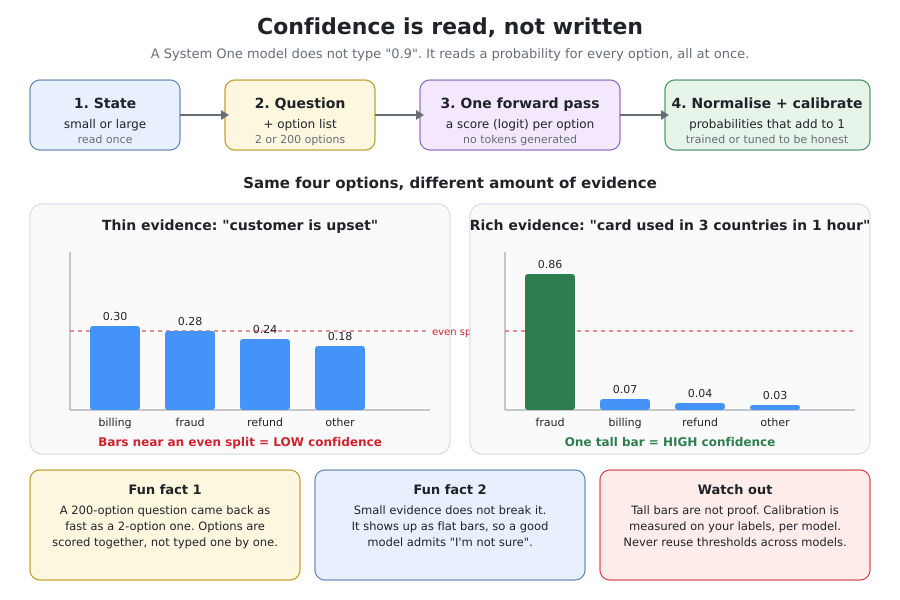
No typed number. An LLM writes “0.9” as text. A System One model scores every option in one forward pass and turns the scores into probabilities that add up to 1.
Confidence is distance from an even split. One tall bar means high confidence. Bars that are all about equal mean low confidence.
Thin evidence gives flat bars. With only “customer is upset”, four options might land near 0.30, 0.28, 0.24 and 0.18. That is a low-confidence answer, and your gate should send it to a human. With “card used in 3 countries in 1 hour”, fraud might reach 0.86.
Training and tuning keep the bars honest. Jev is trained so its probabilities match how often it is right (RLCD). Kev applies a fitted temperature, which rescales the bars without changing which option wins.
Interested in learning System One with two capstone projects on FinTech and Industrial IoT.
Explore the full architecture blueprint, production ready reusable foundation code, complete code implementations, and interactive diagrams in Mastering Jev: Type-Safe System 1 AI in Production book.

Architecting deterministic, sub-second decision layers for mission-critical systems.
Deterministic Primitives: Replace brittle JSON prompt schemas with
Choice,Score, andNoul.Sub-Second Latency: Low-overhead System 1 probabilistic inference designed for high-throughput streaming.
Real-World Capstone: Full architectural implementation covering autonomous FinTech fraud triage and Industrial IoT edge control.